God willing, I'll be in Denver on Sunday night.
Classes start Monday at 9am.
That how my life seems to roll.
I am sad to be leaving this place and these experiences.
But more than anything, I am thankful.
It has been priceless.
For the last couple years, I have been homeless, and yet somehow I have had a sense of home wherever I have gone. Today, my home is in East Jerusalem. There are so many people here who have become a family to me, and their struggles, pain and joy have become mine.
I'll carry that with me no matter where my body rests at night.
Here's to another transition.
Adios Jerusalem.
Salaam and Shalom.
Showing posts with label Jerusalem. Show all posts
Showing posts with label Jerusalem. Show all posts
Saturday, March 21, 2009


Monday, March 2, 2009
the demolitions begin.

I'm in the office today working on a grant to the EU.
However, we just got a call saying that a home in Silwan was just demolished, and several more are scheduled for today and tomorrow. The government is finally acting on its plans to demolish 88 homes in the neighborhood of Silwan. This comes just a week after the government issued a statement saying that there were no 'immediate plans' to demolish homes in this area.
These homes are part of the group of homes I have been profiling as part of my internship. Though the families I know personally have not yet been affected, I fear for the near future.
My heart aches for the families who are losing homes on this cold and rainy day.
Some background on the Silwan demolitions:
Christian Science Monitor
Washington Times
Saturday, February 21, 2009
Silwan Profile 2: Family of 43
A large part of my internship at Rabbis for Human Rights has become creating home profiles for homes that are under demolition order. My second day of home profiling in Silwan took me to the home of the Abu-Naj family.  This family's story is a tough one. They have 43 people living in their house. (This includes two brothers, a sister and all of their children and grandchildren). Their family moved into the house after the 1948 war, when they were forced to leave their former homes in West Jerusalem. Since then they have been paying rent to a man who recently died. Upon his death, a Jewish* settler family claimed the house as being theirs (from before the 1948 conflict I suppose). They refuse to take rent payments or offers to buy the house from the Palestinian family and demand that they leave the house. To further complicate matters, because of their large and growing family, the Abu-Naj's have added on several rooms to the original structure of the house. After the settler family made a claim on the house, the government issued a demolition order on the parts of the house that were not part of the original structure, saying that it was built without a building permit (Arabs are essentially NEVER given building permits by the government to build in Jerusalem, so almost all houses are built without permits - in fact, pretty much the entire neighborhood of Silwan is under demolition order because of this). And to even FURTHER complicate matters, the settler family that is claiming the house says that the house itself has some sort of religious significance and therefore has even more reason to not be a home to this family. Eek.
Here is the head of the household with two of his grandchildren. He painted the room himself and says that he likes to go there to pray and be alone (with 43 people in the house this is a rare space).

This is Fakhri, a community leader and my contact/translator in Silwan. He picks me and the other volunteers up at the entrance of the neighborhood and walks with us to the homes that we are profiling. (Thank goodness or I would probably STILL be wandering around lost). Unfortunately, his home is also under demolition order. It is in his home that I participated in my first interview and profile.
 Each interview cannot start without 2 or 3 wonderful cups of mint tea (with lots of sugar) and cannot continue without a VERY THICK cup of coffee (complete with a pile of grounds at the bottom of each cup). I have never, ever liked coffee, but I have learned to breathe deeply and get enough of it down (after pouring in about 4 spoonfuls of sugar) to be polite. I learned that drinking it quickly is a big mistake as then I am just given another cup. Slow sipping is key. Needless to say, each interview ends with me on a sugar and caffiene high.
 This interview was hard, as I could tell right away that they would have a very tough case and if everything continues at the status quo, will lose their house. It is hard to sit and get to know these people and experience their hospitality and see their love for their home and family and realize that in a week or less, their home may be rubble and they will either be forced to crowd in with neighbors or be on the street. That said, at the end of this interview, I got a special treat because two of the grandchildren who live in the home peeked in the door to visit. They are beautiful and animated children who were especially excited about seeing their images on my camera. I look at these pictures and hope.. I don't even know for what exactly. For peace? For them to learn to forgive and coexist despite what has happened in their pasts and present? For them to value and to be valued as humans instead of by ethnicity, religion or race? For them to be blessed with extra heapings of resilience and optimism?

*Note: This does not mean that all Jews in Jerusalem do the things or believe in the things that this particular settler family is doing. In fact, the vast, vast majority would not. Even further, there are many Jews in Jerusalem (including my organization Rabbis for Human Rights and most of my Jewish friends and people I interact with daily) who outright condemn that this is happening. This has nothing to do with Jews vs. non-Jews, or even Israelis vs. non-Israelis. It is an extremist attitude that unfortunately a few powerful people and families have adopted, and even more unfortunately, that the government has not stopped. One of the most shocking things that I have learned is that many (if not most) people (even in Jerusalem) do not know that this is happening, or if they do know, they do not know the extent of it or its affect on the individuals, families and communities.
 This family's story is a tough one. They have 43 people living in their house. (This includes two brothers, a sister and all of their children and grandchildren). Their family moved into the house after the 1948 war, when they were forced to leave their former homes in West Jerusalem. Since then they have been paying rent to a man who recently died. Upon his death, a Jewish* settler family claimed the house as being theirs (from before the 1948 conflict I suppose). They refuse to take rent payments or offers to buy the house from the Palestinian family and demand that they leave the house. To further complicate matters, because of their large and growing family, the Abu-Naj's have added on several rooms to the original structure of the house. After the settler family made a claim on the house, the government issued a demolition order on the parts of the house that were not part of the original structure, saying that it was built without a building permit (Arabs are essentially NEVER given building permits by the government to build in Jerusalem, so almost all houses are built without permits - in fact, pretty much the entire neighborhood of Silwan is under demolition order because of this). And to even FURTHER complicate matters, the settler family that is claiming the house says that the house itself has some sort of religious significance and therefore has even more reason to not be a home to this family. Eek.
Here is the head of the household with two of his grandchildren. He painted the room himself and says that he likes to go there to pray and be alone (with 43 people in the house this is a rare space).

This is Fakhri, a community leader and my contact/translator in Silwan. He picks me and the other volunteers up at the entrance of the neighborhood and walks with us to the homes that we are profiling. (Thank goodness or I would probably STILL be wandering around lost). Unfortunately, his home is also under demolition order. It is in his home that I participated in my first interview and profile.
 Each interview cannot start without 2 or 3 wonderful cups of mint tea (with lots of sugar) and cannot continue without a VERY THICK cup of coffee (complete with a pile of grounds at the bottom of each cup). I have never, ever liked coffee, but I have learned to breathe deeply and get enough of it down (after pouring in about 4 spoonfuls of sugar) to be polite. I learned that drinking it quickly is a big mistake as then I am just given another cup. Slow sipping is key. Needless to say, each interview ends with me on a sugar and caffiene high.
 This interview was hard, as I could tell right away that they would have a very tough case and if everything continues at the status quo, will lose their house. It is hard to sit and get to know these people and experience their hospitality and see their love for their home and family and realize that in a week or less, their home may be rubble and they will either be forced to crowd in with neighbors or be on the street. That said, at the end of this interview, I got a special treat because two of the grandchildren who live in the home peeked in the door to visit. They are beautiful and animated children who were especially excited about seeing their images on my camera. I look at these pictures and hope.. I don't even know for what exactly. For peace? For them to learn to forgive and coexist despite what has happened in their pasts and present? For them to value and to be valued as humans instead of by ethnicity, religion or race? For them to be blessed with extra heapings of resilience and optimism?
*Note: This does not mean that all Jews in Jerusalem do the things or believe in the things that this particular settler family is doing. In fact, the vast, vast majority would not. Even further, there are many Jews in Jerusalem (including my organization Rabbis for Human Rights and most of my Jewish friends and people I interact with daily) who outright condemn that this is happening. This has nothing to do with Jews vs. non-Jews, or even Israelis vs. non-Israelis. It is an extremist attitude that unfortunately a few powerful people and families have adopted, and even more unfortunately, that the government has not stopped. One of the most shocking things that I have learned is that many (if not most) people (even in Jerusalem) do not know that this is happening, or if they do know, they do not know the extent of it or its affect on the individuals, families and communities.
Monday, February 9, 2009
Transport Frustrations
YESTERDAY:
(wave down taxi)
me: Silwan for 20 shekels?
cab driver: no
me: 25?
cab driver: no - its Arab neighborhood.
me: ugh, fine.
(wave down next taxi)
me: Silwan for 20 shekels?
cab driver 2: no, its Arab
me: fine.
(wave down next taxi)
me: Silwan for 20 shekels?
cab driver 3: (drives off)
repeat a few more times... 7th or 8th cab driver is Arab, so we are in luck, get a ride to Silwan.....
later that day in Silwan:
(wave down taxi)
me: Mount Scopus for 20 shekels?
cab driver 4: no, its Jewish.
you have got to be kidding.
TODAY:
I have to catch an 'Arab' bus to Azarya, the Bedouin village where I work with the teachers (yes, there are "arab" buses and "main/public" buses- they go to different neighborhoods)
I am standing at a 'public' bus stop near my university waiting for Arab bus #36 to come along.
THREE 36's pass me without stopping, despite frantic waving gestures/jumping out into the road.
Why? Why are they not stopping??? I look around - what could it be? I have no idea. The only thing I can think of is that there are a bunch of soldiers around me... but they are all relaxed and just sitting waiting for a bus- I don't know. Maybe a there is a rule against them stopping there? They seem to stop EVERYWHERE else - I don't get it.
So after waiting for almost an hour, I haul myself and my half broken leg down a hill into Isawiyya - an Arab village right by where I live - and of course, a #36 bus stops immediately.
Seriously, folks - what gives? There has to be some easier way of transferring between the Jewish and Arab worlds here.
A side note - on the #36 on the way home, I was the only person on the bus for a while. For whatever reason, the people on bus #36 are SO nice to me. The other day, they drove out of the way to drop me where I needed to go (at the insistance of the people sitting around me). Today, the bus driver bought me a bag of salted soy beans (or something - maybe chickpeas?) from a street vendor - they were delicious, and I was touched.
(wave down taxi)
me: Silwan for 20 shekels?
cab driver: no
me: 25?
cab driver: no - its Arab neighborhood.
me: ugh, fine.
(wave down next taxi)
me: Silwan for 20 shekels?
cab driver 2: no, its Arab
me: fine.
(wave down next taxi)
me: Silwan for 20 shekels?
cab driver 3: (drives off)
repeat a few more times... 7th or 8th cab driver is Arab, so we are in luck, get a ride to Silwan.....
later that day in Silwan:
(wave down taxi)
me: Mount Scopus for 20 shekels?
cab driver 4: no, its Jewish.
you have got to be kidding.
TODAY:
I have to catch an 'Arab' bus to Azarya, the Bedouin village where I work with the teachers (yes, there are "arab" buses and "main/public" buses- they go to different neighborhoods)
I am standing at a 'public' bus stop near my university waiting for Arab bus #36 to come along.
THREE 36's pass me without stopping, despite frantic waving gestures/jumping out into the road.
Why? Why are they not stopping??? I look around - what could it be? I have no idea. The only thing I can think of is that there are a bunch of soldiers around me... but they are all relaxed and just sitting waiting for a bus- I don't know. Maybe a there is a rule against them stopping there? They seem to stop EVERYWHERE else - I don't get it.
So after waiting for almost an hour, I haul myself and my half broken leg down a hill into Isawiyya - an Arab village right by where I live - and of course, a #36 bus stops immediately.
Seriously, folks - what gives? There has to be some easier way of transferring between the Jewish and Arab worlds here.
A side note - on the #36 on the way home, I was the only person on the bus for a while. For whatever reason, the people on bus #36 are SO nice to me. The other day, they drove out of the way to drop me where I needed to go (at the insistance of the people sitting around me). Today, the bus driver bought me a bag of salted soy beans (or something - maybe chickpeas?) from a street vendor - they were delicious, and I was touched.
Sunday, February 8, 2009


Church of the Holy Sepulcher

 Last week I finally had the opportunity to get back to the Old City and visit the Christian
 quarter. The highlight was the Church of the Holy Sepulcher (Sep-pull-ker). The church marks
the place where it is believed that Jesus was
crucified, cleaned, buried in a tomb, and rose from the dead.

I was amazed by the opulence of the place - it was the most ornate place I have perhaps ever been. The picture to the left is of the place where Jesus is said to have hung from the cross - (you have to climb stairs to get up the hill of Golgotha and to the height of where he was hung). Just look at the ornateness!! I know that to so many, this is a way of worship, but to me, it completely overwhelmed the space and - overwhelmed me.

It was so completely surreal to stand in the places from which all of Christianity is based - and look around at all of the different versions of Christians... it was actually incredibly overwhelming to me. I wasn't entirely sure what to think or how to feel about it. On almost every wall hundreds of thousands of crosses had been carved in over the last several hundred years. It was utterly
 amazing. The picture below of the people sprawled on the ground is of the rock where it is believed that Jesus was cleaned when he was taken off of the cross. Many people would kneel near it, and rub all sorts of things over it in order to make them holy. I saw a lady take literally everything out of her purse, including her cell phone, ipod, kleenex, a pair of earrings and a nail file, and rub them all over the rock.
Wow - huh? To go to the place where my religion originated - that's big, right? HU
 GE, right? And yet - it was more than anything to me a moment where I realized that our religion, our spirituality, our theology - is something that is interpretable a million different ways, across a million different cultures and 6 billion different individuals. Just looking at even the way that this space had been utilized over the years was mind blowing - there were catholic quarters of building, and orthodox, and coptic, and fransiscan and armenian.... monks from allllll sorts of backgrounds - women completely covered, women in little tiny skirts with bellies showing - truly, it is amazing to me the number of ways that Christianity (and any religion for that matter) has been interpreted.
I have now had the chance to stand in the holiest site for Christians, the holiest place for Jews, and the most sacred of places for Hindus - and ... I think I love religion less for all of it.
BUT I surely love people more and am continually amazed at humanity's continual search for divinity. And, at the very end of the day, still....there is no doubt that...

:)
Friday, January 30, 2009
Museum on the Seam
[image location]
Today, my program took us to the 'Museum On the Seam'. It is in an old home that belonged/belongs to a Palestinian family. It was taken over by the Israeli army in the 1948 war, and because of its unique 'on the seam' location, it was used for years as a military lookout. From the windows on the top floor, you look right over the border that runs down the city of Jerusalem that used to divide West Jerusalem/Israel from East Jersalem/Jordan. Since 1967, East Jersalem has been annexed by Israel and is considered by the Israeli government to be a part of Israel. Next door, 'project' housing was put up by the Israeli government for immigrant Jews from Eastern Europe. It was controversial because (among other things) many of those immigrants felt that they were made into human sheilds by being placed in housing directly on the border between warring nations. Phew.
ANYWAY, the exhibit that was there today is called Heart Quake. You can click on the link to read more about it, but the general idea of most of the art is to get a dialogue happening about the effects of conflict on society and the individual. Many of the pieces were powerful.
Three that stood out to me the most:
It was me/Diary - this piece was a giant wall mural that looks like a diary. Each of the entries was written in the frist person:
This piece was by far the most powerful to me, mainly because before I came to Jerusalem, the conflict in Gaza was SO heavily on my heart and mind - and then when I moved here, I couldn't see signs of it ANYWHERE - life just seemed to be going on as normal.. This piece really spoke to me about that phenomenon and its lack of reality:

ANYWAY, the exhibit that was there today is called Heart Quake. You can click on the link to read more about it, but the general idea of most of the art is to get a dialogue happening about the effects of conflict on society and the individual. Many of the pieces were powerful.
Three that stood out to me the most:
It was me/Diary - this piece was a giant wall mural that looks like a diary. Each of the entries was written in the frist person:
"This work is a unique diary created by Daniela Comani. Curator Inke Arns notes that 365 journal entries, written in the first person, report important events that occurred in the twentieth century. The fictitious narrator signs the agreement for dismantlement of the Warsaw Pact on March 31, is killed on June 2 by police bullets during a demonstration in East Berlin, blocks the path of a tank on Tienamen Square in Beijing two days later, and assaults a Vietnamese trader on the streets of Hoyerswerda in Germany on September 17. Comani has written a diary of the twentieth century as though all the events depicted happened to her. From one day to the next, from one report to the next, she is first a passive witness, then a political activist, later - a victim, and then again goes on to commit crimes. Thus she seems to instigate these historic events."Beach, 2006 -
This piece was by far the most powerful to me, mainly because before I came to Jerusalem, the conflict in Gaza was SO heavily on my heart and mind - and then when I moved here, I couldn't see signs of it ANYWHERE - life just seemed to be going on as normal.. This piece really spoke to me about that phenomenon and its lack of reality:
"Guli Silberstein’s work presents a personal report in the form of an unfocused television broadcast; a stream of images progressively speeding up, portraying a family on a Tel Aviv beach, near to a video work showing a little girl running frantically along a Gaza beach under bombardment, a mere 100 km. away. The work depicts a reality wherein tranquility is transformed momentarily into terror, and the possibilities of the real and the repressed pose questions simultaneously conceptual, existential and moral.
Paradoxically, the observer is drawn to the blurred images, and the more they blur, the greater the sense of confusion and dread over what goes on between Tel Aviv and Gaza, between the flickering narrative and his tempestuous imagination. Silberstein’s cinematic language, the deliberate disorder injected into the development of the action, fills us with a growing sense of danger and dread."
Thursday, January 29, 2009
Jerusalem Map Madness
 So, I should just put it out there that I am the worst person with directions... EVER. I have been lost in more cities, in more countries on more continents than ANYONE should be allowed. I really don't know how I have survived this long, considering the amount of traveling I have done. I STILL have troubles once in a while in my home town (population 8000) - let alone major cities in countries where I don't speak the language OR read the script.
So my one saving grace so far has been that I am half decent at reading maps (I say 'half' generously). This has always been my tactic - find a map, orient myself, get lost, ask someone to point to me where I am on the map, get lost again, etc. Eventually I find what I am looking for.. usually.
Well, I have never run across a place QUITE like Jerusalem. Yes, I have a map... and sometimes I even remember the name of the place I am supposed to be going (the words don't really 'stick' since the sounds are still foreign to me)... but find it on a map?! It would seem so easy..
Fortunately, most road signs and maps have names in Hebrew, Arabic, and English, but oh, the horror of TRANSLITERATION - meaning that Hebrew words don't necessarily have a perfect English spelling equivalent, so people have just sounded them out. Take a word like 'Caesarea' for example - when looking on a map or a road sign, it may be 'Qisariyya, Kesarya, Qasarya... etc. (Thanks Lonely Planet for the example) Or maybe the Hebrew word will be used instead of the English one - Yerushalayim instead of Jerusalem.... you get the idea.
So I just got instructions from one of the Rabbis at Rabbis for Human Rights as to how to get to my internship (starting Sunday) - and spent about an hour and a half figuring out what those directions actually meant on the map - and now I have to figure out which buses to take to get there, and which stops to get off at - all while guessing from about 5 or 6 name choices for each of those variables.
Don't get me wrong, its do-able (mainly because I will ask people the whole way and probably call everyone I know once or twice) - but seriously, it is not the most intuitive situation. To make it worse, there is no bus map in English... so its all just word of mouth, the not-so-trusty--non-bus-map, and of course my sense of direction. Oh boy.
Friday, January 23, 2009
Jerusalem Sunset
 One evening, I stayed late in class because I was waiting for a symposium to start - and this is the view from our classroom, at sunset.
Jerusalem Holocaust Museum
Last Sunday, we visted the Jerusalem Holocaust museum and the International School for Holocaust Studies. I have been to a few Holocaust Museums, but this one had a different feel to it, mainly because almost every Jew in Jerusalem has some direct connection back to the Holocaust - either they or someone in their family survived it. Our guide told us that pre-Holocaust there were about 18 million Jews in the world, and afteward, after the systematic slaughter of 6 million, there were 12 million. Today, there are only just over 13 million Jews, meaning that the population STILL has not recovered its numbers. Just terrible.
However, there was a very intersting Zionist twist at the end of the museum - a view looking over Jerusalem. One of the main reasons that Israel became a state was that the United Nations wanted to create a place for the Jews after the Holocaust - they had been persecuted and murdered all over Europe, Western Asia, and the United States had closed its doors to massive immigration - they literally had no place to go.
So they were given a place in Palestine. But the Palestinians weren't exactly 'asked' if this was ok.... enter conflict that still rages today.

At the beginning of our tour, we were able to go into a room, put on head phones, and hear experts answer questions we could choose about the Holocaust. It was very interesting.However, there was a very intersting Zionist twist at the end of the museum - a view looking over Jerusalem. One of the main reasons that Israel became a state was that the United Nations wanted to create a place for the Jews after the Holocaust - they had been persecuted and murdered all over Europe, Western Asia, and the United States had closed its doors to massive immigration - they literally had no place to go.
So they were given a place in Palestine. But the Palestinians weren't exactly 'asked' if this was ok.... enter conflict that still rages today.


The Wailing Wall
This is perhaps one of the most recognizable images in the world: the Dome of the Rock behind the Wailing Wall, and of course me cheesing it up in the foreground:
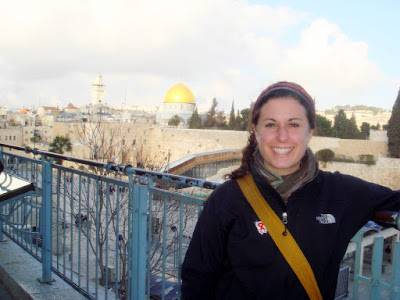
The gold dome is the Dome of the Rock, a memorial to where Muslims believe that Mohommad ascended into heaven to talk with God (Allah). That wall, right in front of the dome, is the Wailing wall, one of the last remaining walls of the Second Temple. If you look hard, you can see people right in front of the wall - those are Orthodox Jews praying. Many pray that the temple will be reestablished in this place. Of course, that isn't cool with the Muslims whose 3rd most holy place is right in the middle of what the Jews believe should be the 3rd temple. Eek. ALl of this conflict, all of this war over the Holy Lands - radiates from right in this spot.


It was an amazing experience to be at a place that is considered the very most Holy by so many people - but it is also overwhelming to see how adamant people are about it - it is not a rational thing, it is not something that people will compromise about --- and it makes peace extremely complicated. My little piece of paper was one of millions and millions stuck into the wall, and I know some people were praying for probably the exact opposite thing that I was. Oh, Jerusalem.
Old City: The Jewish Quarter

 Orthodox Jews heading to the Wailing Wall:
 Orthodox children playing among ancient Roman columns:
 The Mount of Olives, where it is believed that people will be resurrected first after the coming of the Messiah. To get a head start, over 150,000 Jews have been buried here - there are no longer any olive trees, after which the mount was named... just graves.
 Security cameras - everywhere. Security is super tight in Jerusalem, far more than anywhere I have ever been. However, interestingly, there is almost no petty or individual crime (robbing, murder, petty thief, etc...) just... some big attacks. I don't know if that makes me feel better or not. Regardless, TONS of security.
 Right outside the Jewish Quarter are the ancient baths from which the tradition of baptism has been derived. In the times of the temples, Jews would come to these baths to be spiritually cleansed before they would take their 1/2 shekle and sacrifice (usually a goat, lamb, calf, dove or whatever their best animal was) to be burned at the temple. The would be fully immersed, and then change into white clothing. The Temple was just about a 4 or 5 minute walk from here.
 Rght near the ruins of the baths, you can see the church of the Rooster, the place where is it believed that Peter denied Jesus 3 times before the crowing of the rooster:
 A statue of David. However, no statue is supposed to stand on HOly Places....


This is another picture of the room of the Last Supper/Pentacost. I wasn't quite sure whether I should take pictures or not. Different people react differently when entering this room - our guide said that often charismatic Christians will being yelling and jumping around, and that some even bang their heads on the walls so hard that they have to go to the hospital. I'm not really sure what to think about that either way - this picture is a group I think from Russia, who walked into the room and broke into song - I recognized the melodies of some of the hymns that they sang, but not the words.

Subscribe to:
Posts (Atom)